


The Importance of Hands-On Learning in Today's Classrooms

Updated: Apr 28
Across the United States, schools are facing a growing challenge that teachers, parents, and administrators increasingly agree on. Student attention is under pressure. Smartphones, social media, and constant digital stimulation are reshaping how students focus, interact, and learn.
Many districts are now debating phone bans or restrictions during the school day. Researchers, educators, and policymakers are asking the same question: How can schools help students regain focus and engagement in the classroom?
Some of the answers being discussed involve policy. Others involve technology restrictions. But another approach is gaining attention among educators who see the problem every day. Students need more learning experiences that are active, collaborative, and hands-on.
The Role of Experiential STEM Education
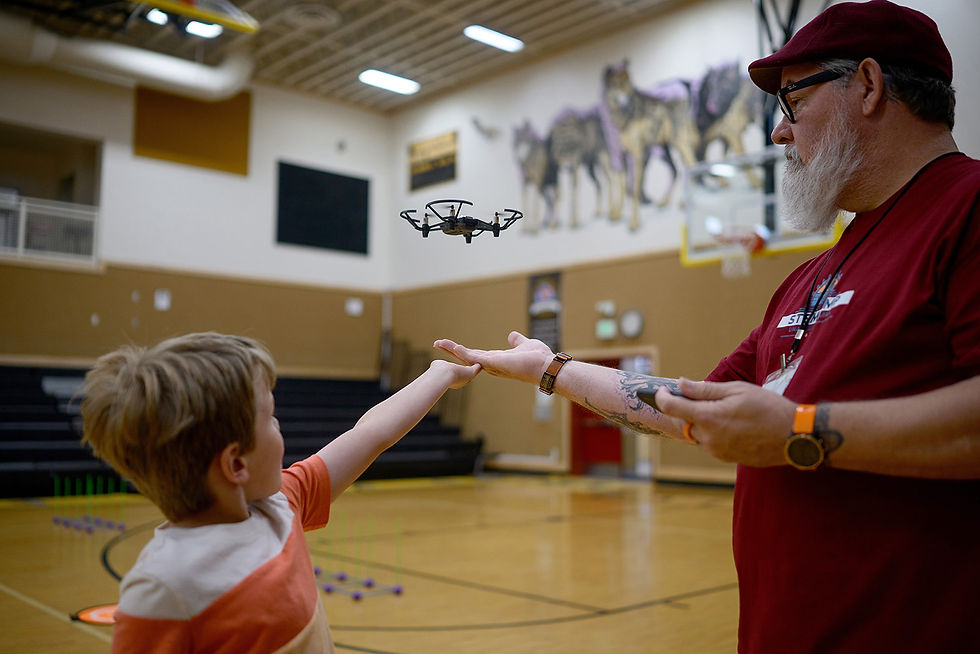
This is where experiential STEM education plays a critical role. Hands-on STEM programs shift students from passive consumption to active participation. Instead of staring at screens, students build, test, design, fly, and solve real problems together. When implemented well, these programs capture attention in ways traditional instruction often struggles to match.
Drone-based STEM learning is one example of this approach, and programs such as Drone Legends STEM Fundamentals are designed specifically to harness the power of hands-on learning to develop real skills and deeper engagement.
The Growing Concern About Phones in Schools
The debate around smartphones in schools has intensified in recent years. Many educators report that student attention spans have declined while classroom distractions have increased.
Students now carry powerful entertainment devices in their pockets. Notifications, social media feeds, games, and messaging platforms compete constantly for attention. Even when phones are not actively in use, the expectation of incoming notifications can interrupt concentration. Teachers frequently describe a classroom environment where focus must compete with digital distractions.
Several countries and states have begun experimenting with school day phone restrictions. The goal is simple: reduce distractions and restore a learning environment where students can focus on meaningful work. However, removing phones alone does not solve the larger challenge. Students still need learning experiences that capture their attention in positive ways.
Why Passive Learning Struggles to Compete for Attention
Many classroom activities still rely heavily on passive learning models. Students read, listen, watch, and complete worksheets. These approaches have long been part of education, but they compete poorly with the stimulation students experience through digital media.
Phones deliver rapid feedback, movement, novelty, and interaction. Passive learning rarely matches those qualities. When classroom learning feels static or disconnected from real life, attention drifts quickly.
This does not mean technology itself is the problem. Technology can support learning when used intentionally. The issue arises when students spend most of their academic time consuming information rather than applying it. Active learning environments produce different results.
Students who are building, experimenting, and solving problems must focus on the task in front of them. Collaboration, movement, and experimentation create natural engagement that does not rely on constant digital stimulation. Hands-on STEM education is one of the most effective ways to create these environments.
What Hands-On STEM Learning Looks Like
Hands-on STEM learning places students in situations where they apply scientific, engineering, and computational concepts to real challenges. Instead of learning concepts in isolation, students experience how those ideas function in real systems.
Examples include:
Engineering design challenges
Robotics programs
Drone flight missions
Environmental data collection
Coding projects with physical systems
These activities engage multiple dimensions of learning. Students must think critically, communicate with teammates, test ideas, observe outcomes, and adjust strategies. The learning process becomes interactive and dynamic.
This type of learning aligns closely with modern workforce skills. Many careers require individuals to analyze information, operate technology, collaborate with teams, and solve unfamiliar problems. Drone education has emerged as a particularly powerful example of this learning model.
Why Drone-Based STEM Learning Captures Student Engagement

Drones combine several powerful learning elements in a single platform.
First, drones introduce students to real aviation technology. Flight operations involve aerodynamics, navigation, spatial awareness, and safety procedures. Second, drones integrate coding and automation. Students can program flight paths, adjust parameters, and test algorithms through real hardware.
Third, drones collect visual data through cameras. Aerial imagery allows students to observe environments from new perspectives and analyze real information. Finally, drones naturally encourage teamwork. Safe drone operations require coordination between team members who take on roles such as pilot, observer, and safety monitor.
These features transform drones from simple gadgets into powerful educational tools. When students participate in structured drone missions, they experience technology as a tool for solving real problems.
The Importance of Career-Connected STEM Education
Another advantage of drone-based learning is its connection to real industries. Drones are used today in agriculture, environmental monitoring, infrastructure inspection, filmmaking, emergency response, and logistics. These industries require skilled operators who understand both technology and problem solving.
Introducing students to these concepts early can spark career curiosity and expand awareness of future opportunities. Career-connected STEM education helps students answer an important question: Why does this learning matter?
When students see how STEM concepts apply to real work environments, motivation often increases. Learning becomes purposeful rather than abstract. Programs that integrate career awareness with academic standards provide a powerful bridge between classroom learning and future pathways.
What Makes a Strong Drone Curriculum for Schools
Not every drone activity creates meaningful learning outcomes. Schools need structured curriculum systems that guide students through progressively deeper challenges. A strong drone curriculum typically includes several elements:
Clear alignment to educational standards ensures the program supports academic goals.
Mission-based learning structures give students real problems to solve.
Coding integration helps students understand automation and computational thinking.
Data capture through cameras allows students to analyze information and present findings.
Team-based roles promote collaboration and communication.
Programs designed around these principles help teachers deliver both engagement and rigor. Drone Legends STEM Fundamentals was developed specifically to meet these needs.
How STEM Fundamentals Brings Hands-On STEM to the Classroom

Drone Legends STEM Fundamentals is a structured drone curriculum designed for grades four through eight. The program combines hands-on drone flight, coding missions, and real-world scenarios to help students develop STEM skills and problem-solving abilities.
Each mission places students into a team-based structure inspired by real drone operations. Students may take on roles such as Remote Pilot in Command, Visual Observer, or Safety Manager while completing mission challenges. These roles mirror how professional drone teams operate in real environments.
Students learn to coordinate tasks, communicate clearly, and follow operational procedures. The curriculum includes ten problem-based missions that immerse students in real-world scenarios. Activities involve tasks such as mapping environments, delivering supplies, analyzing ecosystems, and producing aerial video projects.
The program integrates both drone flight and coding instruction so students understand manual control and autonomous operations. This combination helps students see how technology functions in real systems rather than isolated exercises. The curriculum also aligns to widely recognized education standards including NGSS, ISTE, CSTA, and Common Core subject areas.
For educators, the program functions as a turnkey system. The kit includes curriculum guides, mission materials, drones, safety equipment, and professional development resources to support classroom implementation. This structure allows teachers with zero drone experience to successfully run the program.
Hands-On Learning Helps Students Reconnect With School
Programs like STEM Fundamentals highlight a broader shift happening in education. Students are not disengaged because they lack curiosity. Most students are deeply curious about the world around them. Disengagement often occurs when learning feels disconnected from action, creativity, and real impact.
Hands-on STEM experiences change that dynamic. Students must move, build, observe, test, and adapt. They collaborate with teammates and celebrate progress as they complete mission objectives. These experiences transform learning from passive observation into active exploration.
Many teachers report that students who struggle to stay engaged during traditional lessons become highly focused during hands-on projects. When learning becomes tangible and interactive, students often rediscover motivation. This does not eliminate the need for foundational knowledge. Instead, it creates a pathway where knowledge is applied and reinforced through real activity.
A Balanced Future for Technology in Education
The conversation about phones in schools is important. Educators must continue exploring policies that support focus and healthy digital habits. At the same time, schools must rethink how technology is used inside classrooms. Technology should not only deliver information. It should enable exploration, experimentation, and problem-solving.
Drone-based STEM programs demonstrate what this balanced approach can look like. Technology becomes a tool that empowers students to create, investigate, and collaborate. When technology supports active learning rather than passive consumption, it becomes a powerful force for education.
The Path Forward
Schools everywhere are searching for ways to strengthen student engagement while preparing learners for future careers. Hands-on STEM education offers a clear path forward. Programs that combine real technology, collaborative problem-solving, and career awareness can help students rediscover the excitement of learning.
Drone-based learning environments provide exactly that opportunity. By placing students in mission-driven teams, encouraging experimentation, and connecting STEM concepts to real-world challenges, programs like Drone Legends STEM Fundamentals show how active learning can thrive in modern classrooms.
As schools continue navigating the challenges of digital distraction, the solution may not be less technology. The solution may be better technology. Technology that inspires students to stand up, collaborate, think critically, and explore the world around them. Hands-on STEM learning does exactly that.
Contact Drone Legends today to see how easy it is to bring hands-on drone STEM curriculum to your school!


Comments